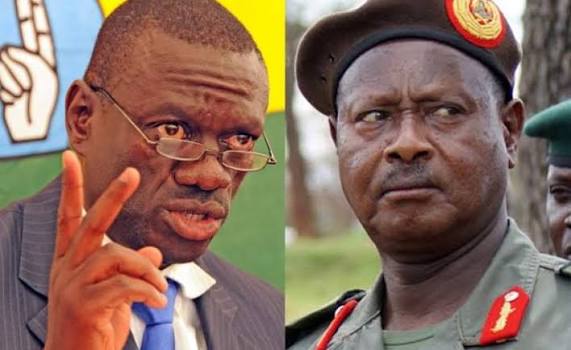
Kizza Besigye has strongly dismissed President Yoweri Museveni’s claims that he is responsible for the prolonged delays in his treason case, telling the High Court that he is prepared to face trial once concerns surrounding his legal representation and access to a fair hearing are fully addressed.
The veteran opposition politician made the remarks on Monday as the High Court commenced hearing the treason case against him and his co-accused, Obeid Lutale.
The proceedings were held before Justice Emmanuel Baguma, with both accused persons being transported from Luzira Prison to attend the hearing.
When Besigye entered the courtroom, he was reportedly wearing handcuffs, a move that attracted attention from observers and members of the legal fraternity present in court.
Justice Baguma ordered prison officers to remove the handcuffs before allowing Besigye to address the court, emphasizing the need to maintain courtroom standards and procedures.
Once given an opportunity to speak, Besigye immediately raised concerns regarding the circumstances under which he had been brought to court and the challenges affecting his legal defence.

The former Forum for Democratic Change (FDC) president informed the court that his legal team had been significantly disrupted in recent months, making it difficult for him to adequately prepare for trial.
He noted that his lead lawyer, Erias Lukwago, had been arrested, while Kenyan lawyer Martha Karua had been deported from Uganda, developments he said had negatively affected his right to legal representation.
According to Besigye, the absence of key members of his defence team had created serious obstacles in the preparation of his case.
He further told the court that despite being in prison for several months, he and his co-accused had not been granted sufficient opportunities to meet their lawyers and review evidence intended to be used by the prosecution.
Besigye argued that a fair trial can only be achieved when accused persons have adequate access to legal counsel and sufficient time to prepare their defence.
He revealed that on July 2, his legal team filed an application seeking remedies concerning issues of legal representation, but no response had yet been received from the court.
The opposition leader also referred to President Museveni’s recent national address, in which the President accused him of deliberately frustrating the judicial process and refusing to stand trial.
In the televised address, Museveni questioned why Besigye, whom he described as a democrat and human rights activist, would allegedly spend considerable effort avoiding a trial where he could prove his innocence.
The President further criticized what he described as weaknesses within the legal system, arguing that no accused person should be allowed to indefinitely delay court proceedings.
However, Besigye strongly rejected those accusations and told the court that the delays had nothing to do with any unwillingness on his part to face justice.
He insisted that the unresolved concerns regarding legal representation, access to evidence, and court records were the real issues preventing the defence from proceeding.
Besigye also disclosed that repeated requests for copies of previous court proceedings had not been fulfilled, making it difficult for the defence team to properly understand and prepare for the case.
In one of the most striking moments of the hearing, Besigye emphasized that neither he nor any other accused person would choose to remain incarcerated unnecessarily.
“Once these issues are resolved, we shall have access to the disclosure, obtain the records we need, and be ready for trial. Nobody wants to stay in prison,” he told the court.

The opposition leader further attempted to address Museveni’s public remarks, arguing that statements made by the President about an ongoing case directly affected questions of fairness and justice.
He maintained that the President’s comments were relevant because they touched on matters that were still before court and could influence public perception of the proceedings.
Justice Baguma, however, declined the request and ruled that the court would not discuss the President’s address during the hearing, directing that attention remain focused on the legal representation issues raised by the defence.
Despite Besigye’s insistence that the comments formed part of the challenges facing his case, the judge maintained his position and instructed both sides to proceed with matters directly related to the trial.
The hearing continued with discussions centered on the defence team’s concerns, as the court seeks to determine how the case will proceed amid ongoing disputes over representation and access to legal resources.
The high-profile treason case remains one of Uganda’s most closely watched political trials, with supporters of both the government and opposition closely monitoring every development as the judicial process unfolds.