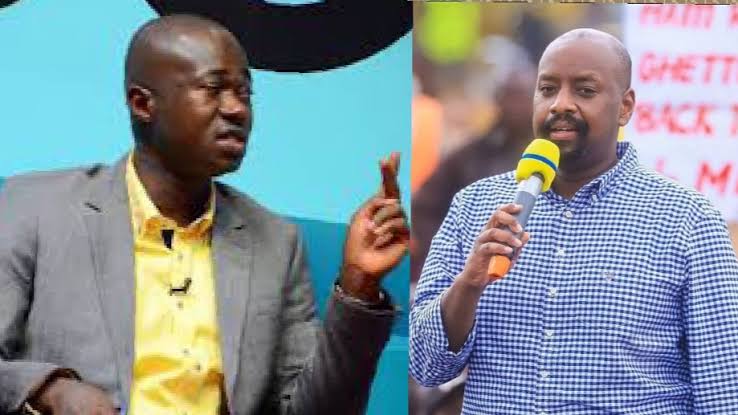
Daudi Kabanda has spoken out strongly after being removed from his position as Secretary General of the Patriotic League of Uganda (PLU), claiming that he faced serious internal threats and pressure that forced him to step aside.
Kabanda revealed that his departure was not just a normal resignation but a decision influenced by growing concerns about his personal safety within the organisation.
He said he had personally requested Gen. Muhoozi Kainerugaba to allow him resign from the position, arguing that the environment had become increasingly tense.
According to Kabanda, his time in the PLU leadership was marked by deep internal mistrust and competition among members struggling for influence and access to the top leadership.
He alleged that some individuals within the movement were using the organisation for personal financial gain rather than its stated civic and political objectives.
Kabanda further claimed that certain people were misleading others by promising access to PLU leadership in exchange for money, a practice he described as corruption and exploitation of the movement’s name.

In a shocking remark, he warned that such internal rivalries had become so intense that they could even lead to physical harm, suggesting that his own safety had been at risk.
Although he did not directly name any individuals, his comments pointed to what he described as a growing struggle for control, influence, and financial advantage within the organisation.
His allegations have sparked widespread debate in political circles, with many observers now questioning the internal stability of the PLU as it continues to expand its influence.
The PLU, which originated as the “MK Movement” before rebranding, has increasingly positioned itself as a major civic and political mobilisation platform closely linked to Gen. Muhoozi Kainerugaba.
Following Kabanda’s resignation, Gen. Muhoozi moved quickly to confirm the leadership change and announced a broader restructuring of the PLU Central Committee.
He stated that Kabanda’s exit was part of a wider reorganisation aimed at strengthening the movement for new challenges ahead.
According to Gen. Muhoozi, the previous leadership team had achieved its objectives, and a new team was now needed to take the organisation forward.
The restructuring saw Kabanda replaced by Fadil Twalla, the Member of Parliament for Tingey County, marking a significant shift in the organisation’s leadership structure.

The changes also extended beyond a single appointment, as several new figures were introduced into the PLU leadership framework.
Among them were Speaker of Parliament Jacob Marksons Oboth and Deputy Speaker Thomas Tayebwa, who were named as special envoys to Parliament.
This move has been interpreted by political analysts as an effort to strengthen PLU’s presence within formal state institutions and decision-making structures.
Critics argue that the restructuring further blurs the line between civic mobilisation and state political operations, given the growing involvement of senior government officials.
Supporters, however, maintain that the changes are part of organisational growth and strategic positioning ahead of future political developments.
As tensions and speculation continue, Kabanda’s dramatic exit and allegations have added a new layer of controversy to the PLU’s evolving political role in Uganda’s power landscape.