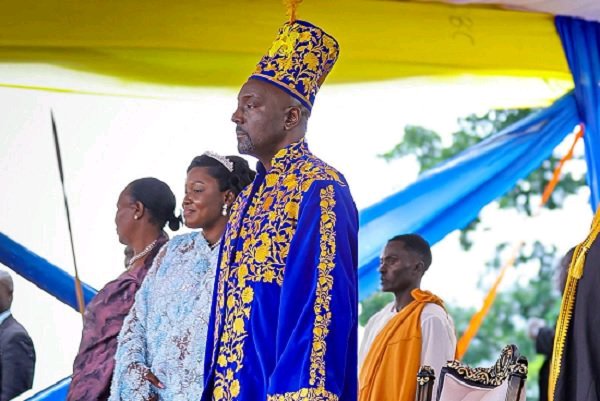
The enthronement of Prince Edward Rukidi Kiijanangoma as the 15th Omukama of Tooro has brought renewed attention to the history linking the Tooro and Bunyoro royal families. Rather than retaining his personal name, the new king took the throne name Omukama Nyabongo I, a decision that has attracted interest among Batooro and other Ugandans. According to historian and journalist Wilson Akiiki Kaija, the name carries a deep historical meaning and reflects both the shared origins of the two kingdoms and the circumstances surrounding the latest Tooro succession.
The roots of the story go back to the 19th century, when Tooro emerged from Bunyoro after Crown Prince Kaboyo Olimi Kasunsunkwanzi rebelled against his father, Omukama Nyamutukura Kyebambe III. Kaboyo had been expected to inherit the Bunyoro throne, but following the disagreement, he established a separate kingdom that became Tooro and became its first Omukama. The split did not end the relationship between the two royal houses, which remained closely connected through the Babiito dynasty.
Kaija explains that the choice of Nyabongo I is partly connected to the history of Omukama Mugenyi, who later ruled Bunyoro as Nyabongo II. Mugenyi was selected to succeed his father after Kaboyo rejected the opportunity to return to Bunyoro and instead continued ruling Tooro. When Mugenyi eventually became Omukama of Bunyoro, he adopted the name Nyabongo II in recognition of an earlier Bunyoro king who had carried the same name. The historical connection has now been reflected in the naming of Tooro’s new king.
There are also striking similarities in the circumstances under which Mugenyi and Kiijanangoma assumed their respective thrones. Mugenyi became king as a mature man after his father had ruled for many years, while Kiijanangoma took the Tooro throne at the age of 56. According to Kaija, the succession elders also associated Mugenyi with qualities such as humility, obedience and a sense of responsibility, characteristics they believed were evident in Kiijanangoma. These parallels helped influence the decision to give the new king the name Nyabongo I.
The succession process itself also contained an unexpected similarity. Before Mugenyi became king of Bunyoro, his brother Kaboyo had declined the opportunity to succeed their father and went on to establish Tooro. In the recent Tooro succession, the committee initially considered another royal candidate, George Desmond Kamurasi, who reportedly declined for personal reasons. Kiijanangoma subsequently emerged as the preferred candidate. To the elders involved in the process, the circumstances carried echoes of the historical events surrounding Mugenyi and Kaboyo.
The Babiito Clan Succession Committee says the choice of the new king was based on a detailed assessment rather than simply his position within the royal family. The 21-member committee considered three shortlisted candidates against social, cultural, economic, political and cognitive qualities. They examined issues including character, reputation, knowledge of Tooro traditions, financial responsibility, ability to work with kingdom institutions, education and willingness to learn. On September 9 at Karuziika Palace, Prince Edward Rukidi Kiijanangoma was announced as the selected successor to the late King Oyo Nyimba Kabamba Iguru Rukidi IV.
The new king’s transition from Kiijanangoma to Nyabongo I was later reinforced through important traditional and institutional ceremonies. During the burial of King Oyo at the Karambi Royal Tombs on September 12, Kiijanangoma performed the Iziba rite, which involved casting nine coffee berries into the grave of his predecessor and symbolised the transfer of royal authority. On September 15, the Tooro Kingdom Supreme Council unanimously endorsed him, giving further institutional backing to his succession before he formally took on the mantle of the new Omukama.
The name Nyabongo I therefore represents far more than a royal title. It connects the new Tooro king to the intertwined history of Tooro and Bunyoro, the legacy of Nyabongo II Mugenyi and the circumstances that brought Kiijanangoma to the throne. The 56-year-old former journalist and news anchor, who spent much of his career telling the stories of others, now finds himself at the centre of one of Tooro’s most significant chapters. While history explains why he was given the name Nyabongo I, the character of his reign will ultimately determine what that name comes to mean for the people of Tooro.