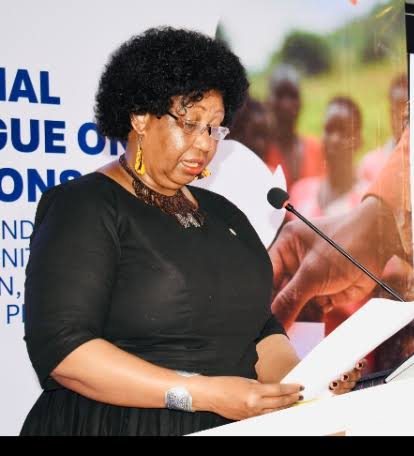
A deepening conflict within the Uganda Human Rights Commission (UHRC) has come into the spotlight after three commissioners openly opposed Chairperson Mariam Wangadya. The disagreement gained national attention after Wangadya publicly spoke about the challenges she has faced at the Commission and alleged that some of her critics are being supported by politicians she previously exposed over corruption-related allegations.
During a media interview on July 3, 2026, Wangadya disclosed that she had been warned about possible difficulties before she even assumed office in 2021. She recalled that after her parliamentary vetting, two Members of Parliament accompanied her out, with one cautioning her that a fellow commissioner would make her leadership journey extremely difficult.
According to Wangadya, the warning soon became a reality. She said her first interaction with the commissioner convinced her that the relationship would be troubled after the individual allegedly boasted about having played a role in the removal of former Energy Minister Irene Muloni through a report submitted to the President.
The UHRC boss stated that she had never encountered such a hostile work environment during her years in public service. She claimed the commissioner frequently told her that security agencies, including ISO and CMI, had opened several files concerning her activities.
Despite the repeated claims, Wangadya said she remained unfazed because she had always carried out her duties professionally. She stressed that since entering government service in 1996, her conduct and loyalty to the country had never been questioned.
She further alleged that she was often reminded that she was not originally from Western Uganda and was repeatedly told that she would not complete her six-year term at the helm of the Commission.
Wangadya also accused some commissioners of encouraging reports alleging that she was under investigation. She described those reports as part of a deliberate effort to tarnish her image and weaken her authority.
The Chairperson claimed that the campaign is being supported by politicians whom she had earlier accused of soliciting bribes. In her view, the sustained attacks against her would not have been possible without outside financial and political backing.
She further alleged that one of the legislators she testified against in court has remained determined to damage her reputation. She also accused a media house of continuously amplifying allegations against her while promoting what she described as ethnically biased narratives.
According to Wangadya, although President Yoweri Kaguta Museveni later forgave the MPs implicated in the corruption matter, they have never forgiven her for bringing the allegations to light.
She insisted that she acted within the law and fulfilled her responsibilities as a public servant.
The UHRC Chairperson appealed to the Director of Public Prosecutions to reconsider a case in which she was the complainant. She noted that she had already given testimony and remained willing to undergo cross-examination if the matter is reopened.
She argued that allowing the case to proceed would provide an opportunity for the public to determine whether the statements she made to investigators and the President were truthful. If the case cannot be revived, she said she would like permission to release an audio recording related to the matter.
Wangadya also raised concerns about the appointment process for members of the Uganda Human Rights Commission. She emphasized that the institution’s constitutional mandate requires leaders who possess unquestionable integrity and professional credibility.
Citing constitutional provisions governing the Commission, she noted that commissioners are expected to be individuals of high moral standing and proven integrity. She expressed disappointment that some appointees, in her opinion, do not fully reflect those requirements.
The veteran public servant highlighted her own record, noting that she has spent three decades in government service, including eight years as Deputy Inspector General of Government and a period as Acting IGG. Throughout that time, she said, she consistently rejected bribes and refused to misuse public office for personal gain.
She concluded by rejecting claims that she stole money from the Commission, arguing that UHRC operates under a limited budget. Wangadya maintained that if she had been involved in corruption as alleged by some critics, she would have become wealthy during her years at the Inspectorate of Government. She called on journalists to verify information before publication and urged the media to report on the matter fairly and professionally.