dfcu Bank has called for a major shift in how East Africa approaches financing, urging banks, regulators and policymakers to develop an integrated financial ecosystem that can unlock large-scale capital, strengthen industrial competitiveness and accelerate cross-border trade within the region.
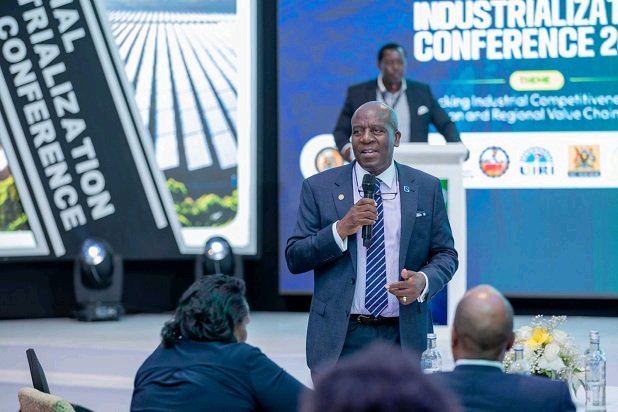
Speaking at the Annual Regional Industrialisation Conference organized by the Private Sector Foundation Uganda (PSFU) at Serena Kampala Hotel, dfcu Bank Chief Executive Officer Charles M. Mudiwa said conventional lending models based mainly on commercial debt are not enough to support the region’s industrial transformation.
Mudiwa argued that capital should not only be measured by the amount of money available but should also include access to markets, technical expertise, business knowledge and skilled human resources. He said successful enterprises require more than financing to produce, expand and compete effectively in regional and global markets.
“Capital is far more than cash. It is market intelligence, knowing where, how and when to sell. Capital is also human capability, the technical skills and competencies needed to deliver value,” Mudiwa said.
He explained that Micro, Small and Medium Enterprises (MSMEs), which form the backbone of many economies in East Africa, require a combination of technical support, financial education and patient capital to overcome the challenges that limit their growth.
To address these challenges, Mudiwa highlighted dfcu Bank’s commitment to supporting businesses through its catalytic funding approach implemented through the dfcu Foundation. The initiative channels part of the bank’s annual profits into affordable financing designed to help enterprises access growth capital without the burden of expensive borrowing costs.
Under the model, selected businesses receive risk capital and repay the principal alongside a small administration fee, allowing them to invest more resources into expansion, production and market development. Mudiwa said the approach has already supported enterprises in sectors including agriculture through initiatives such as cocoa value addition projects in Kasese and school-based poultry programmes.
He said dfcu Bank is working to expand the model beyond supporting local businesses by helping enterprises transition into regional and international markets. According to Mudiwa, the goal is to create stronger businesses capable of competing globally while contributing to job creation, industrial growth and economic development across East Africa.
PSFU Chief Executive Officer Stephen Asiimwe also emphasized the need for stronger cooperation between governments and the private sector to make regional integration more effective. He called for the removal of barriers affecting the movement of goods, services, capital and people across East African Community borders, noting that reducing trade delays and costs is critical for improving business competitiveness.