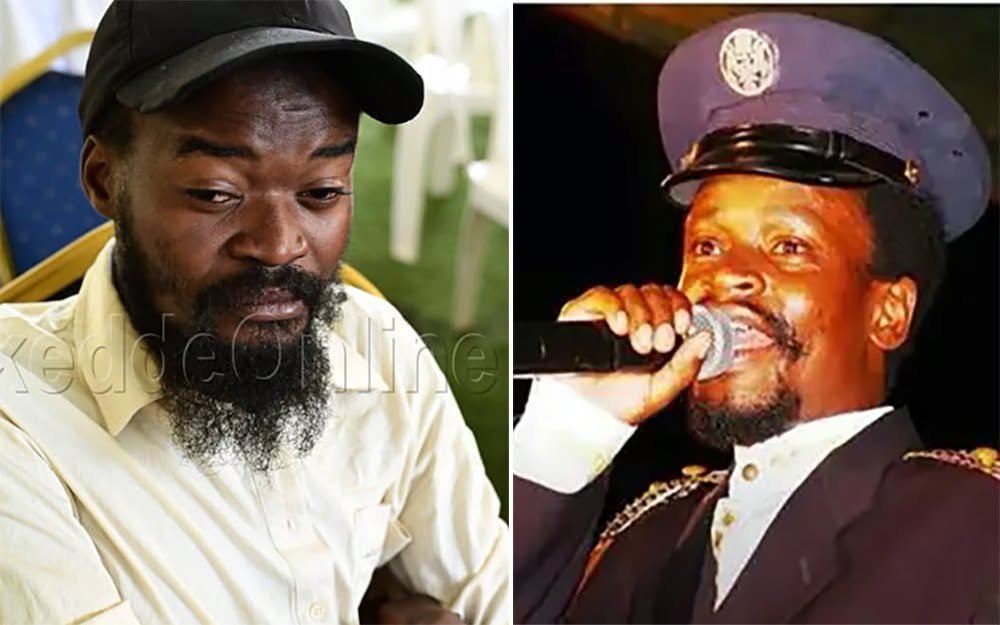
The recently concluded DNA verification exercise involving the family of legendary Kadongo Kamu singer Paul Kafeero has produced shocking results that have left many Ugandans stunned and questioning everything they thought they knew about family resemblance and biological relationships.
For years, several individuals who strongly resembled the late singer were widely accepted by members of the public as his biological children. Their facial features, body structure, mannerisms, and even speech patterns appeared to mirror those of the celebrated musician, convincing many that there could be no doubt about their lineage.
Among the most talked-about claimants was a man who not only carried the name Paul Kafeero but also bore an astonishing resemblance to the late music icon. His appearance had convinced thousands of fans that he was unquestionably the singer’s biological son.
Throughout the years, photographs comparing the two circulated widely on social media, with many observers pointing to their similarities as undeniable proof of a father-son relationship. To many people, the resemblance seemed too strong to be a coincidence.
However, the DNA verification exercise has dramatically changed that narrative. Scientific findings revealed that the man many considered Kafeero’s look-alike son is not biologically related to the late singer, sending shockwaves across the country.
The revelation has become one of the biggest surprises from the entire DNA exercise. Many people who had relied on physical appearance as evidence of paternity found themselves struggling to accept the findings.

Even more surprising was the discovery that some individuals who showed little or no physical resemblance to the late musician were among those scientifically confirmed as his biological children.
The contrast between appearance and biological reality has sparked widespread discussion, with many people admitting they never expected such results. The findings challenged long-standing assumptions held by both family members and fans.
Social media platforms were immediately flooded with reactions as Ugandans debated how individuals who looked so much like Kafeero could fail DNA tests while others who shared few visible similarities with him passed without question.
Experts say the results serve as a reminder that genetics can be complex and unpredictable. While children often inherit physical traits from their parents, those traits may not always be obvious or evenly distributed among siblings.
Some biological children can closely resemble one parent, while others may inherit characteristics from grandparents, great-grandparents, or distant relatives, making family connections difficult to determine through appearance alone.
The findings have also highlighted the importance of scientific testing in resolving paternity disputes, especially in cases where public assumptions and family beliefs have persisted for many years.
According to those involved in the verification exercise, the primary objective was to establish the truth regarding the late singer’s biological children and put to rest years of speculation and competing claims.
The DNA process attracted significant public interest because of Paul Kafeero’s legendary status in Uganda’s music industry and the numerous individuals who came forward claiming to be his children.

As the exercise progressed, expectations remained high among claimants and their supporters, many of whom believed physical resemblance alone would strengthen their cases.
However, when the final results were released, science delivered answers that differed significantly from what many people had expected, proving once again that appearances can sometimes be misleading.
The outcome has triggered broader conversations about identity, inheritance, family history, and the role of modern forensic science in establishing biological relationships.
Many observers believe the results will serve as an important lesson for future generations, emphasizing that resemblance should never be treated as definitive proof of parentage without scientific confirmation.
The wider DNA verification exercise ultimately confirmed only four biological children of the late Paul Kafeero out of the 25 individuals who had come forward with claims, highlighting how difficult it can be to separate fact from assumption.
As the public continues to absorb the findings, the story remains a powerful reminder that while looks may influence perception, DNA remains the ultimate authority when it comes to determining biological family connections.