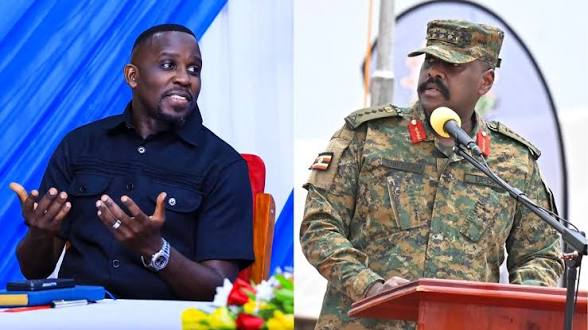
A fresh wave of political debate has emerged after Chief of Defence Forces Muhoozi Kainerugaba made strong remarks about the leadership of Uganda’s opposition in Parliament, specifically targeting the current Leader of the Opposition Joel Ssenyonyi.
In a statement shared on social media, Muhoozi suggested that he has the ability to influence or appoint whoever he wants to the position of Leader of the Opposition, provided he has approval from “Mzee,” a reference widely understood to mean President Yoweri Museveni.
The comments immediately triggered widespread discussion across Uganda’s political landscape, with citizens, politicians, and analysts weighing in on their meaning and implications.
Muhoozi further stated that Joel Ssenyonyi is, in his view, “at best an adhoc Leader of the Opposition,” a remark that quickly became the center of public debate.
The statement has intensified an already heated political atmosphere, where discussions about leadership, opposition politics, and institutional independence continue to dominate national discourse.
Joel Ssenyonyi, who has served as a vocal opposition figure in Parliament, has frequently criticized government policies and actions, making him one of the most visible opposition leaders in recent years.

His role as Leader of the Opposition is recognized within parliamentary structures, where the position is traditionally filled based on opposition party representation rather than external appointment.
Muhoozi’s remarks have therefore raised questions among observers about the boundaries between political influence, institutional processes, and parliamentary procedure.
Supporters of Muhoozi argue that his statement reflects personal political opinion and his belief in leadership restructuring within Uganda’s opposition space.
Some of his supporters say that political leadership should remain flexible and open to change depending on performance and political alignment.
However, critics strongly disagreed, arguing that the Leader of the Opposition is not a position that can be appointed at will, but one governed by established parliamentary rules.
Several commentators warned that such statements risk creating confusion about how Uganda’s democratic institutions function.
Opposition supporters described the remarks as an attempt to undermine the legitimacy of Ssenyonyi’s position and weaken the independence of Parliament.
They insisted that leadership within the opposition is determined internally by elected members of Parliament from opposition parties, not external political actors.

The comments have also reignited debate about the role of the military in political discussions, especially when senior military figures comment on parliamentary leadership.
Political analysts say this is part of a broader pattern where social media statements by influential leaders increasingly shape national conversations.
Some observers believe the remarks are designed to provoke political reaction, while others see them as part of ongoing tensions between government-aligned figures and opposition politicians.
The discussion has spread widely online, with Ugandans expressing divided opinions about whether Muhoozi’s comments represent political ambition, frustration, or personal opinion.
Meanwhile, Parliament and opposition leadership structures remain unchanged, with Joel Ssenyonyi continuing in his role as Leader of the Opposition.
As reactions continue, the statement has added another layer to Uganda’s evolving political debate, highlighting ongoing disagreements about authority, leadership, and the future of opposition politics in the country.