Dr. Lawrence Muganga, the embattled State Minister for Internal Affairs-designate, continues to defend his origins following his rejection by Parliament over allegations regarding his citizenship. The controversy, which has captured national attention, revolves around claims that Muganga holds Rwandan and Canadian passports.
Yesterday, in a bid to silence critics and reaffirm his Ugandan roots, Dr. Muganga visited Mukono District, the area where he grew up. During the visit, he showed off the family home where he spent his early childhood and walked reporters through the land that has been in his family for decades.
Muganga emphasized that those questioning his nationality were motivated by political or personal prejudice rather than facts. “I grew up here for over 40 years. Everything I am today is tied to this land and my family,” he said, speaking passionately to the media.
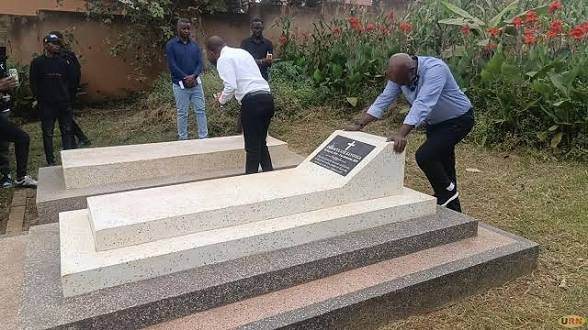
The ministerial hopeful also visited his mother’s grave, underscoring the deep family ties that link him to Uganda. He said that the memory of his parents and the sacrifices they made cemented his identity as a Ugandan.
According to Muganga, allegations labeling him as “Munyarwanda” are unfounded. He accused detractors of spreading false narratives to tarnish his reputation and discredit his public service career. “People say this out of hatred, not truth,” he remarked.
He recounted that his parents fled Rwanda in 1959 amid ethnic violence, finding refuge in Uganda. The family settled in Mukono District, where Muganga was raised, educated, and nurtured, forming a strong connection to his birthplace.

Muganga explained that he was born, raised, and went through primary and secondary school in Uganda. He emphasized that his education in the country laid the foundation for his professional and academic achievements.
He recalled the hardships his family faced as refugees. His parents worked tirelessly to provide for him and his siblings, including his mother who took up various jobs to ensure he remained in school despite financial constraints.
The minister-designate highlighted that he had to engage in small-scale entrepreneurial activities, such as raising rabbits, to contribute to his school fees. He said these early lessons shaped his resilience and determination.
Muganga’s academic journey culminated at Makerere University, where he obtained a Bachelor of Arts in Economics in 2002. He credits his education and experiences in Uganda as pivotal to his subsequent professional success.
In 1996, he followed his family to Rwanda briefly after completing university. However, he insisted that his upbringing, citizenship, and identity remained rooted in Uganda. His professional engagements in Rwanda, he says, were a continuation of career opportunities rather than a change of nationality.
He recounted securing positions in Rwanda’s military training and public service, including teaching history to soldiers and later working as a loans officer and auditor. Muganga insists these roles were professional assignments and did not alter his Ugandan identity.
He later pursued further education in Canada, earning a PhD and legally obtaining Canadian citizenship. Upon doing so, he returned his Rwandan passport and identification to the Rwandan embassy, formally renouncing that citizenship.
Muganga says that when he returned to Uganda in 2019, he informed the immigration authorities of his dual citizenship (Uganda and Canada) and followed all legal procedures to ensure compliance with Ugandan laws.
He reiterated that he has never held Rwandan citizenship illegally, and any claims suggesting otherwise are politically motivated. “I have been transparent with the authorities. My nationality has always been Uganda first,” he stated.

During the Mukono visit, Muganga also highlighted the ancestral and emotional significance of the family home and gravesite, describing them as tangible proof of his Ugandan roots and lifelong connection to the community.
He challenged those who doubt his nationality to consider his upbringing and education in Uganda. Muganga stressed that identity is not determined solely by paperwork but also by the environment in which a person grows and contributes.
The minister-designate expressed disappointment over his parliamentary rejection, stating that the decision overlooked the personal history and sacrifices of his family that tie him indelibly to Uganda.
Muganga called for a fair assessment of public servants based on merit and service rather than heritage or external perceptions. “My life, my work, and my family are all tied to Uganda. That should speak louder than any false accusations,” he said.
He concluded the visit by urging Ugandans to focus on unity and truth rather than divisive narratives. Muganga reaffirmed his commitment to public service and declared his intention to continue defending his origin, asserting that his identity as a Ugandan is unquestionable.
The Mukono visit marks the latest chapter in Dr. Lawrence Muganga’s efforts to publicly assert his Ugandan roots and counter allegations about his nationality. As debates over citizenship and eligibility continue, Muganga remains steadfast in proving his lifelong connection to the country he calls home.