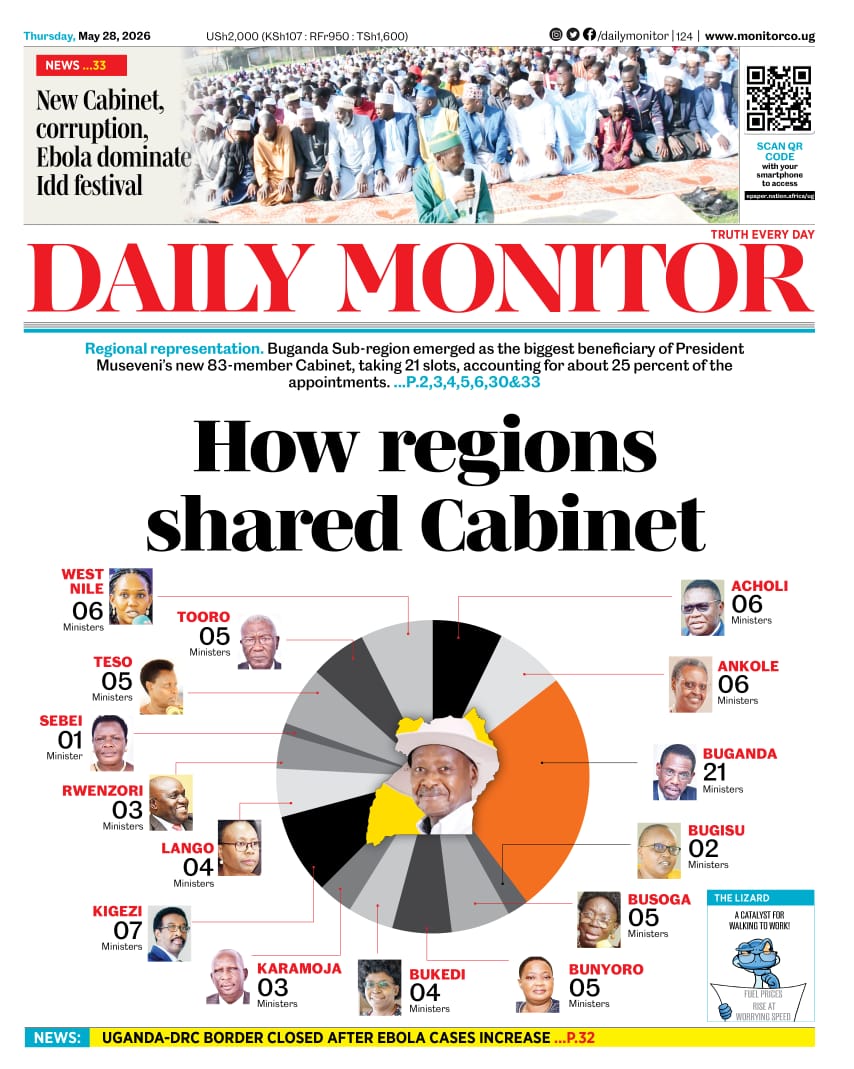
The announcement of Uganda’s new Cabinet has triggered growing discontent in the Bugisu sub-region, where many leaders and residents are questioning what they see as ongoing political sidelining, despite the area’s historical, economic, and political contributions to the country. As discussions about regional balance gain momentum, voices from Bugisu are increasingly calling for fairness and equal representation in national leadership.
Many in the region expressed disappointment after Bugisu appeared to receive only minimal representation in the newly announced Cabinet. For them, this is not just a matter of numbers but a reflection of how the region is valued within the national political framework. While other parts of the country secured multiple key positions, Bugisu ended up with limited inclusion—something local leaders argue does not reflect their region’s long-standing sacrifices and loyalty to the ruling National Resistance Movement (NRM).
Residents and opinion leaders highlight Bugisu’s historical role in Uganda’s development. They point to the Bugisu Cooperative Union as a major economic force, particularly in coffee production and farmer organization. Elders in the region also emphasize that Bugisu communities contributed to national development efforts even before many other regions became politically active.
The region also recalls its historical ties with President Yoweri Museveni during the liberation struggle. Leaders often reference accounts in Sowing the Mustard Seed, where individuals from Bugisu are said to have supported and protected him during challenging times in areas such as Mulukhu and Bumbo. For many residents, these shared historical experiences symbolize loyalty and patriotism that they believe should be recognized in national appointments.
Bugisu is also proud of producing notable national figures, including the late Rt. Hon. James Wapakhabulo, who played an important role in Uganda’s constitutional and political development. Leaders from the region argue that such contributions reflect Bugisu’s consistent commitment to national unity, peace, and state-building, making the current level of Cabinet representation difficult for many to accept.
Political analysts further point out that recent electoral trends have strengthened the region’s support for the NRM, with several districts reportedly increasing their backing for the ruling party in the latest elections. Many supporters believed this political loyalty would be reflected in greater representation within government structures. However, the new Cabinet list has left many feeling excluded and underrepresented.
Some leaders have also raised concerns about why the so-called “mabaati scandal” continues to affect perceptions of Bugisu, while individuals from other regions implicated in similar controversies still hold influential positions in government. They argue that the actions of a few should not be used to deny an entire region opportunities for leadership and national participation.
Despite these concerns, leaders in Bugisu emphasize that their message is not one of anger or division, but rather a call for fairness, inclusion, and equal opportunity. They reaffirm their commitment to national development programs while insisting that the people of Bugisu also deserve recognition and meaningful representation at the highest levels of leadership. As discussions on regional balance continue, the situation in Bugisu is increasingly seen as a broader test of Uganda’s approach to equity, unity, and inclusion in governance.